
Start a Cobb County Records Search
An address is usually the fastest way in. The county's Tax Parcel Viewer takes just the house number and street. Leave off the unit, city, state, and ZIP. Before moving on, copy the PIN, jurisdiction, land district, land lot, and tax district from the result.
A deed index often works better by owner name. Enter it last name first, without a comma. Land district, land lot, subdivision, block, and lot also survive address changes over time. Treat every hit as a lead, not a conclusion. Match the legal description and the recorded instrument before deciding who the owner of record really is.
- Normalize the address and retrieve the parcel card from Cobb GIS.
- Use the PIN and owner lead with the assessor and tax estimator.
- Search the clerk by grantee, grantor, land description, or book/page.
- Check plats, liens, releases, tax status, and the correct city permit source as needed.
- Order a plain or certified copy, or use the archive and public-record request routes when the web record is incomplete.
Offices Holding Cobb County Records
Three county custodians split the main work, and each answers a different question. The Superior Court Clerk records deeds and other land instruments. The Board of Tax Assessors sets values each year. The Tax Commissioner bills and collects on the tax roll. Cobb GIS adds parcel and jurisdiction context, but it is not a title office.
Superior Court Clerk
10 East Park Square, Building C
Marietta, GA 30090-9640
770-528-1360
Board of Tax Assessors
736 Whitlock Avenue, Suite 200
Marietta, GA 30064
770-528-3100
Cobb County Deed Index Modes
The clerk's index runs on several modes. These include Name, Land, Street, Book/Page, Cross Reference, CFN, and Instrument. Name mode lets you set a date range. You can also pick book type and category, grantor or grantee direction, and instrument type. Enter people last name first, no comma, and partial names are fine. The official Cobb County clerk name search shows those party-direction and record filters in action.
Land mode accepts land district, land lot, subdivision, block, lot, unit, and a date range. It also covers book and instrument type, party direction, and a referenced name. Street mode reaches only from January 1, 1999 forward. The index carries filings through October 1, 2024. So anything later needs confirmation through the office or the eFile route.
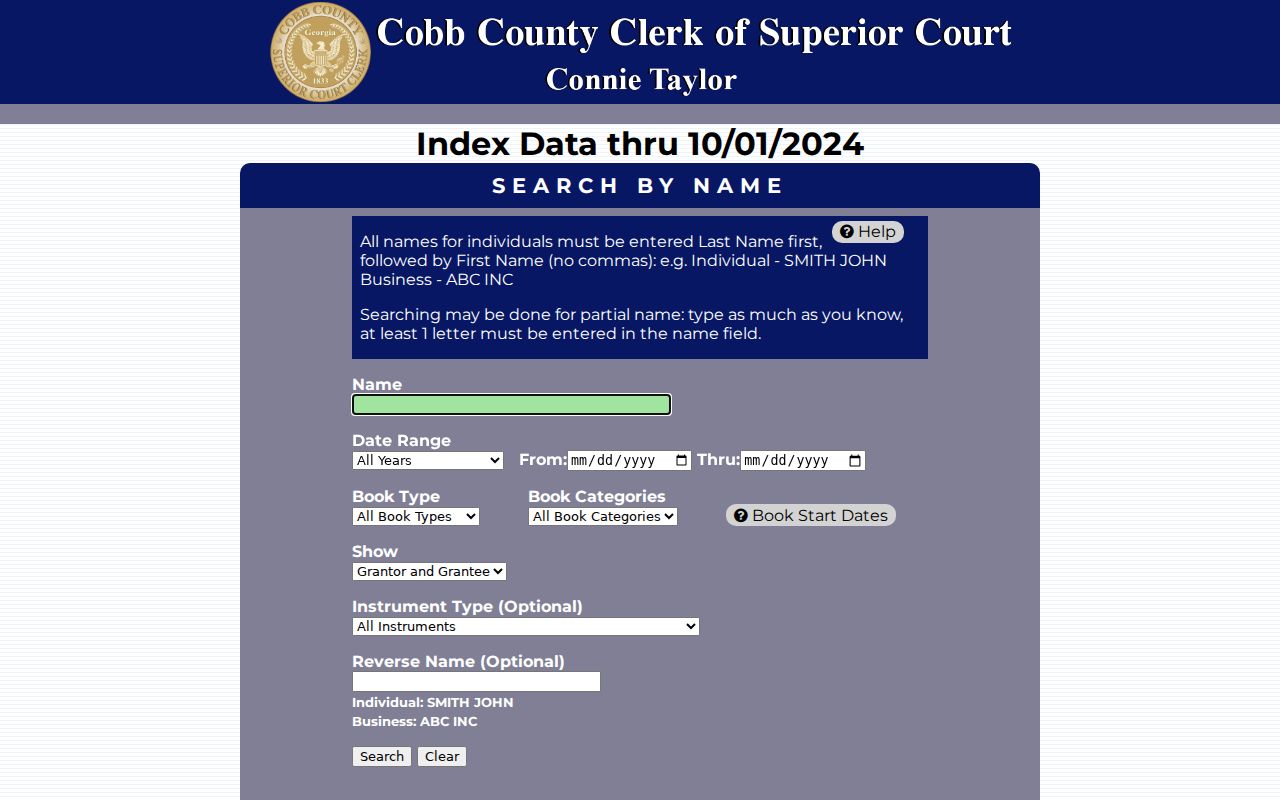
The captured form is useful for planning the query before opening any result image.
| Search mode | Best key | Use |
|---|---|---|
| Name | Grantor or grantee | Transfer and lien chain |
| Land | District, lot, subdivision | Plats and changed addresses |
| Book/Page | Known citation | Exact document retrieval |
| Instrument | Record type and date | Deeds, releases, liens, plats |
Read a Cobb County Parcel Card
A Cobb parcel card packs a lot into one screen. It lists the PIN, land district and lot, jurisdiction, situs address, class, tax district, and ZIP. Some cards add zoning and future land use for unincorporated parcels. Others add commission, fire, police, sheriff, voting, and school fields.
Take one example, a Whitlock Road parcel in unincorporated Cobb. Its card shows an 11-character PIN. It also shows tax district 9, land district 16, land lot 703, R-20 zoning, and residential future land use. That single card routes the search to the right offices. It is still not a valuation, deed, survey, or title conclusion.
Cobb County Assessment Calendar
January 1 is the assessment date, and Cobb reviews property every year. Georgia law generally sets assessed value at 40% of fair-market value for ordinary real property. Special classes and exemptions change the math on a tax bill.
Annual notices go out before July 1. The 2026 notices were mailed June 5 with a revised estimated-savings display. A written appeal must arrive, or be USPS postmarked, within 45 days of the notice. A metered-mail date does not count, and the county grants no extension.
Note: A taxpayer return filed from January through April reports a claimed value. It is not an appeal.
Cobb County Property Record Types
Think of Cobb County property records as a packet rather than a single file. Start with the record type that answers your immediate question, then keep its identifiers handy so a second custodian can confirm the same parcel.
| Record Type | What It Documents | Kept By | Access |
|---|---|---|---|
| Deeds and plats | Transfers, legal descriptions, lot layout | Superior Court Clerk | Index, image, counter, mail |
| Liens and releases | Recorded claims and later satisfaction | Superior Court Clerk | Name or instrument search |
| Assessment | Fair-market value, assessed value, class, appeal | Board of Tax Assessors | Linked search, forms, office |
| Tax | Bill, exemptions, payment, sale and excess funds | Tax Commissioner | Portal, email, phone, mail |
| Parcels and zoning | PIN, land lot, jurisdiction, reference geometry | Cobb GIS and city | Viewer and map services |
Recorded transfers and instruments belong in Cobb County deed records. Value and billing questions go to the separate tax sources. Permit, zoning, and historic-review records may fall to Marietta, Mableton, Smyrna, or another city once GIS confirms the jurisdiction.
Cobb County Tax Estimate Limits
The county tax estimator accepts a parcel ID, an address, or an owner name. Results return class, district, type, retrieval date, tax year, fair-market value, assessed value, estimated taxes, homestead exemption, and owner. The 2026 display runs on 2025 millage and assessment inputs.
Agricultural and special classifications are excluded, as are parcels under administrative review. City tax, penalties, interest, delinquent balances, and fees stay separate. Print or save the estimate, then check it against the actual Tax Commissioner bill.
Cobb County Tax Sale Records
The Tax Commissioner posts a tax-sale booklet and claim forms. Current sale lists are there too. So are delinquent lists and excess-funds files. Taxes unpaid after October 15 can be levied and sold. Notices run in the Marietta Daily Journal for four Fridays before a sale.
A buyer at a Cobb tax sale gets a tax deed, not immediate possession. The owner, or another statutory redeemer, generally has 12 months to redeem. Premiums and costs get added on. A tax deed never removes the need to inspect prior deeds. Liens, releases, notices, and any later court action matter too. Excess funds point to a surplus process, not to the present owner of record.
Historic Cobb County Land Records
Cobb County was carved from Cherokee lands in 1832. That old land-lot grid still shapes search fields in today's Cobb County property records. The Civil War brought harder losses. A courthouse loss in 1864 left gaps in county civil archives, so a missing deed record from that period is a gap, never proof that no transaction occurred. Other sources extend the historic trail. The Georgia Archives county-record card, tax digests, plat indexes, county microfilm, probate files, and the Georgia Room at the Cobb library can each add a link. Georgia Archives and Georgia State University microfilm covers much of the bound record through about 1900. A careful search names each repository and unresolved link.
Cobb County E-Filing and Copies
Since January 1, 2025, most self-filers must submit real-estate documents through the GSCCCA system. Individuals also clear identity and photo verification. Listed professional and government filers may keep paper options. Confirm eligibility, formatting, PT-61 rules, and payment first. Copies stay cheap. Office copies run 50 cents per page, and certification adds $2 per document, whether picked up in person or sent by courier. Mail requests must be written and prepaid by cashier's check or money order, since personal checks are not accepted. The clerk cannot give legal advice or run a full search over the phone.
Cobb County Recording Alerts
Land-record fraud is a real worry for any owner of record in Cobb County. The clerk's Fraud Alert Notification System offers a safeguard. It watches a personal or business name. It sends an electronic notice whenever a matching document is filed with the recorder. Signing up takes a few details: name, contact information, parcel, street, ZIP, and legal-description fields.
Understand what the alert does. It is not title insurance, and it neither blocks nor validates a filing. Think of it as an early prompt. When a notice arrives, read the recorded image. Match its legal description against your own. Contact the clerk or qualified counsel if a deed seems false or unrelated.
Cobb County Cities Change Routing
A mailing city proves nothing about municipal limits. The GIS Jurisdiction field is the routing key in Cobb County. It settles the question first. Marietta runs its own nightly property search and permit system. Smyrna takes a different path, pairing a parcel map with an online permit route. Mableton picked up planning, zoning, and code duties on March 3, 2025. That change came under its modern charter.
For a city parcel, note the date you checked the boundary. Then pull both the county land records and the city permit or zoning source. Historic cases can sit with a prior custodian. Mableton is the clearest example. Its pre-transition Cobb files and later city files may form one permit history.
Marietta's city search wants a street number plus the first four letters of the street name. The instructions warn that mail, utility, and school status do not establish city limits. A formal zoning certification there can return the address, district, land lot, parcel, and zoning. Smyrna's map adds ward and service context. Pair every city result with the county PIN and the clerk's land record.
Cobb Property Terms at a Glance
Cobb County property records lean on short labels with very different legal weight, so keep each term distinct.
- Grantor and grantee
- The parties transferring and receiving the stated interest.
- PIN
- Cobb's parcel identifier, used to reconcile current map and tax records.
- Assessed value
- The assessment base used in taxation, not a sale appraisal.
- Plat
- A recorded drawing of lots, blocks, easements, or subdivision geometry.
- Situs address
- The physical location of the parcel, distinct from an owner's mailing address.
Limits of Cobb County Property Records
Cobb County property records can do a lot. They identify a parcel and surface a tax-roll owner lead. They reveal recorded deeds and liens, and they display assessed values with jurisdiction or map context. They can also mislead. Data may lag, and an index error can creep in. An unrecorded claim may be invisible, and a protected person's name may be withheld. The assessor offers a redaction route for qualifying protected people. That route stands apart from Georgia VoteSafe.
GIS geometry is preliminary planning information. Construction work or a binding boundary decision needs a field survey. An assessment is not an appraisal of likely sale price. A deed index row is not the deed image. For consequential work, preserve each source, date, and identifier, then obtain the certified instrument you need.
When a portal will not surface older or downloadable records, Georgia's Open Records Act gives you a request route to the agency custodian. A focused request should name the PIN, address, record type, date range, and preferred existing format. Written requests are easier to track. State guidance does note that oral requests can be valid. Ask for existing records, not a newly created research report.
Keep the agency response with your search log. A stated date range, a withheld-record reason, a fee estimate, or a no-record response shows later readers exactly what the custodian checked.
Office, phone, mail, and library routes still belong in a full Cobb County property search. The deed room and plat counter can retrieve known references. The assessor and Tax Commissioner can clarify their own dated records. The Georgia Room and state archives help with maps, directories, tax digests, and microfilm. A current web portal may not carry those.
Lawful use. Use Cobb County property records for lawful research and due diligence. A search is not a title opinion or survey, and owner data must never be used to stalk, harass, or harm.