
Chart Cobb County Former Owners
A backward deed chain is a dated sequence rather than a pile of matching names. Start from one known current instrument. Add a row for each earlier transfer. Anchor every row with book/page, CFN, legal description, and prior citations tied to an official record. Never fill in a missing party or date from a directory alone.
| Transfer date | Grantor to grantee | Deed type | Book/page or CFN |
|---|---|---|---|
| Newest verified date | Current deed seller to grantee | Transcribe the label | Exact citation |
| Prior acquisition | Earlier seller to newest grantor | Warranty, quitclaim, executor, or other | Follow prior reference |
| Earlier verified date | Previous grantor to grantee | Use the actual terms | Book or archive citation |
| Unresolved interval | State the missing link | Possible estate, order, or loss | List series searched |
The Superior Court Clerk real-estate index is the current starting point, with displayed data running through October 1, 2024. Verify later recordings with the Real Estate Division.
Cobb County Deed Index Paths
The clerk's index opens along several paths. These include Name, Land, Street, Book/Page, Instrument Type, Cross Reference, and CFN. Name mode takes a date range and a book type or category. You can also set grantor or grantee direction and an optional instrument type. Street mode only reaches back to January 1, 1999. So it cannot carry a deep property history alone. The official Cobb name search displays the party controls used to locate past owners.
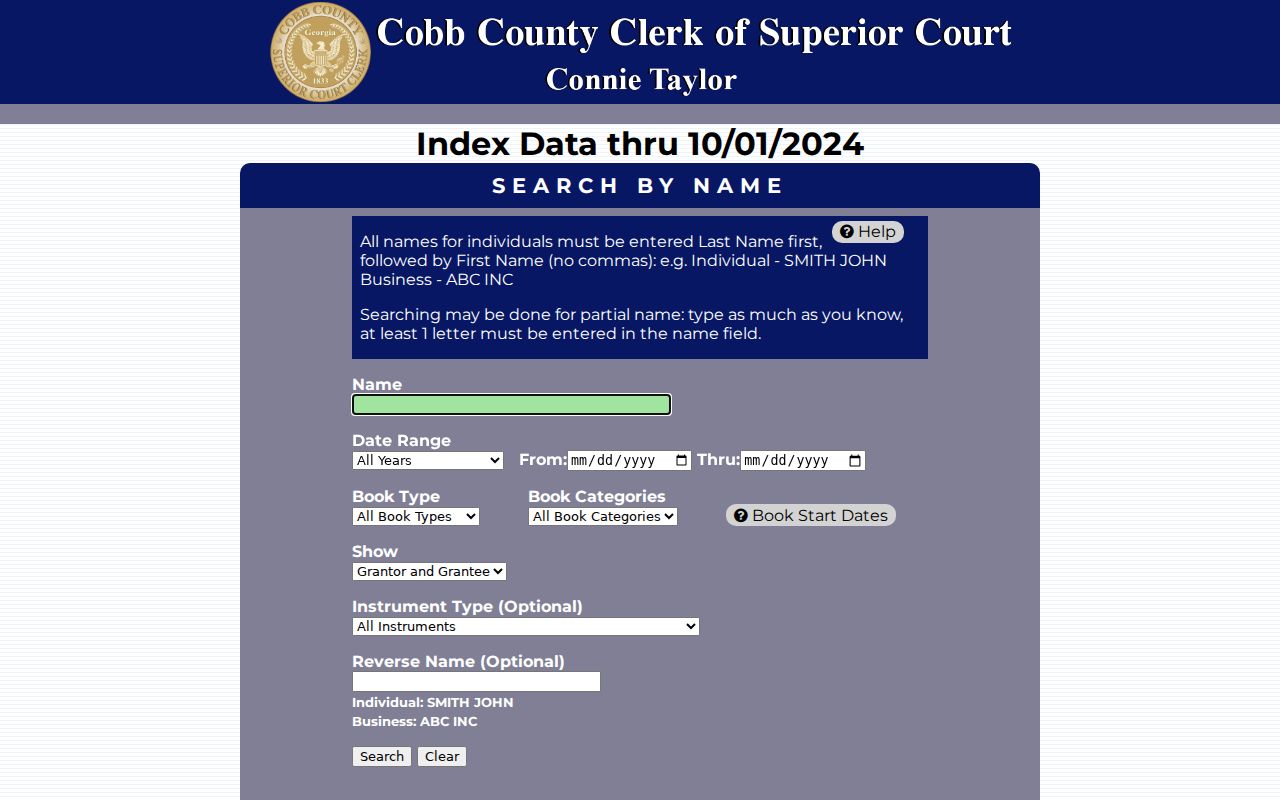
A past owner typically shows up first as grantee when acquiring the land and later as grantor when conveying it. Try spelling variants, initials, and entity suffixes. Search both directions before calling a link absent.
Reverse Cobb County Ownership History
Read the deed image itself, not just its index row. A sample at deed book 14727, page 205 shows prior references to books 3490 page 320, 4398 page 138, 6374 page 511, and 10301 page 476. Treat that as a record-format example rather than the chain for another parcel.
- Transcribe the newest deed's grantee, grantor, recording date, type, citation, and legal description.
- Search that grantor as grantee to find the deed by which the prior owner acquired the land.
- Confirm district, land lot, subdivision, lot, acreage, plat, and prior deed reference.
- Repeat until online sources end, then move to books, microfilm, tax digests, and probate.
- Grantor
- The party conveying the stated interest.
- Grantee
- The party receiving it.
- Chain of title
- The linked sequence of conveyances affecting the same land.
- Reverse index
- An index used to find the receiving party.
- Quitclaim deed
- A transfer of whatever interest the grantor may have, without title warranty.
A correction, executor's deed, court order, or release can explain a name change without fitting a simple sale story. The index is not a title guarantee.
Hold Cobb County Land Fixed
Names and mailing addresses change; the land does not. Preserve the modern GIS PIN plus land district, land lot, subdivision, block, lot, unit, acreage, phase, section, and plat citation. A single older tract can split into several current PINs, and the deed description plus recorded survey form the bridge. The Cobb Land search supplies these address-independent fields.
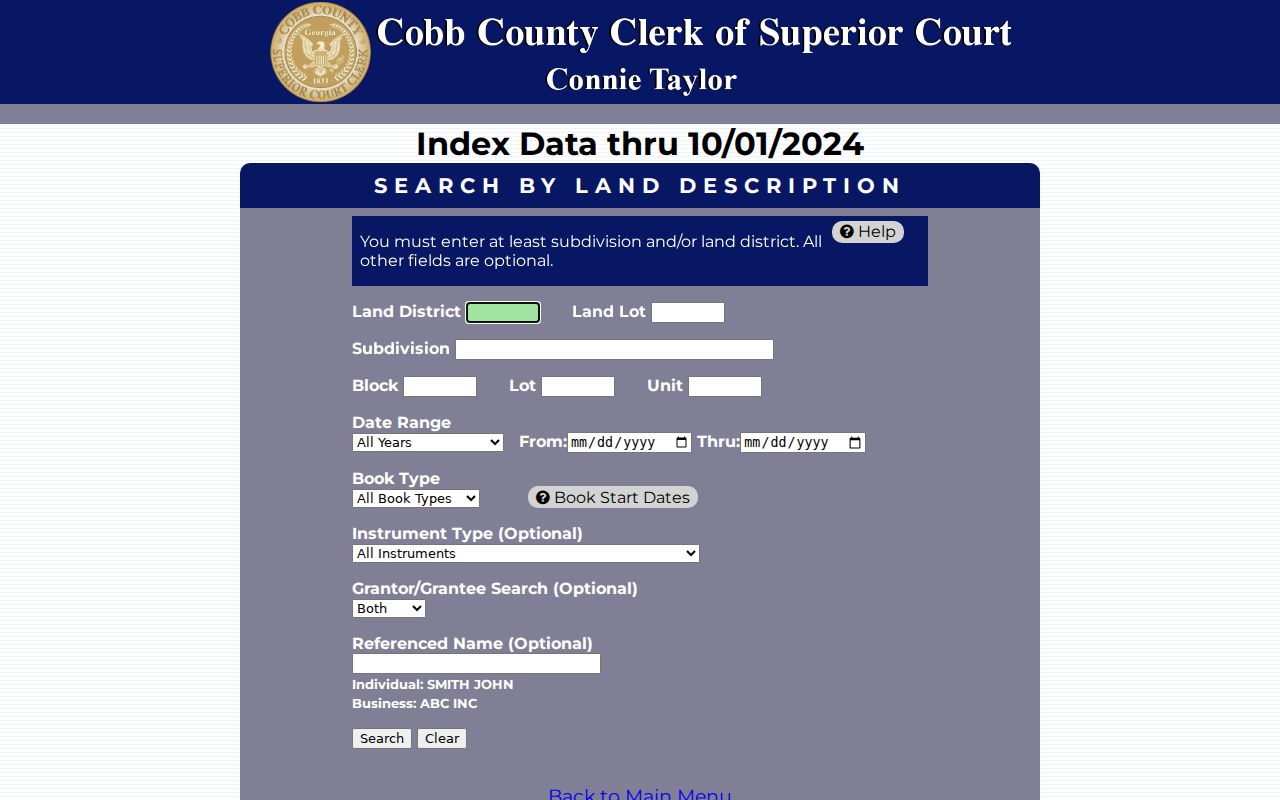
Search subdivision names with and without phases and abbreviations. For metes-and-bounds land, compare bearings, distances, monuments, watercourses, and adjoining owners, since similar acreage never makes two deeds the same parcel.
Cobb County Ownership Beyond Online
The deed room and plat counter sit at 10 East Park Square, Building C, in Marietta. Hours are weekdays 8:30 a.m. to 5 p.m. Recording and copy counters close at 4:30 p.m. Staff will not research documents by phone. The deed room line at 770-528-1328 answers access questions. Mail requests go to P.O. Box 3430, Marietta, GA 30061-3430.
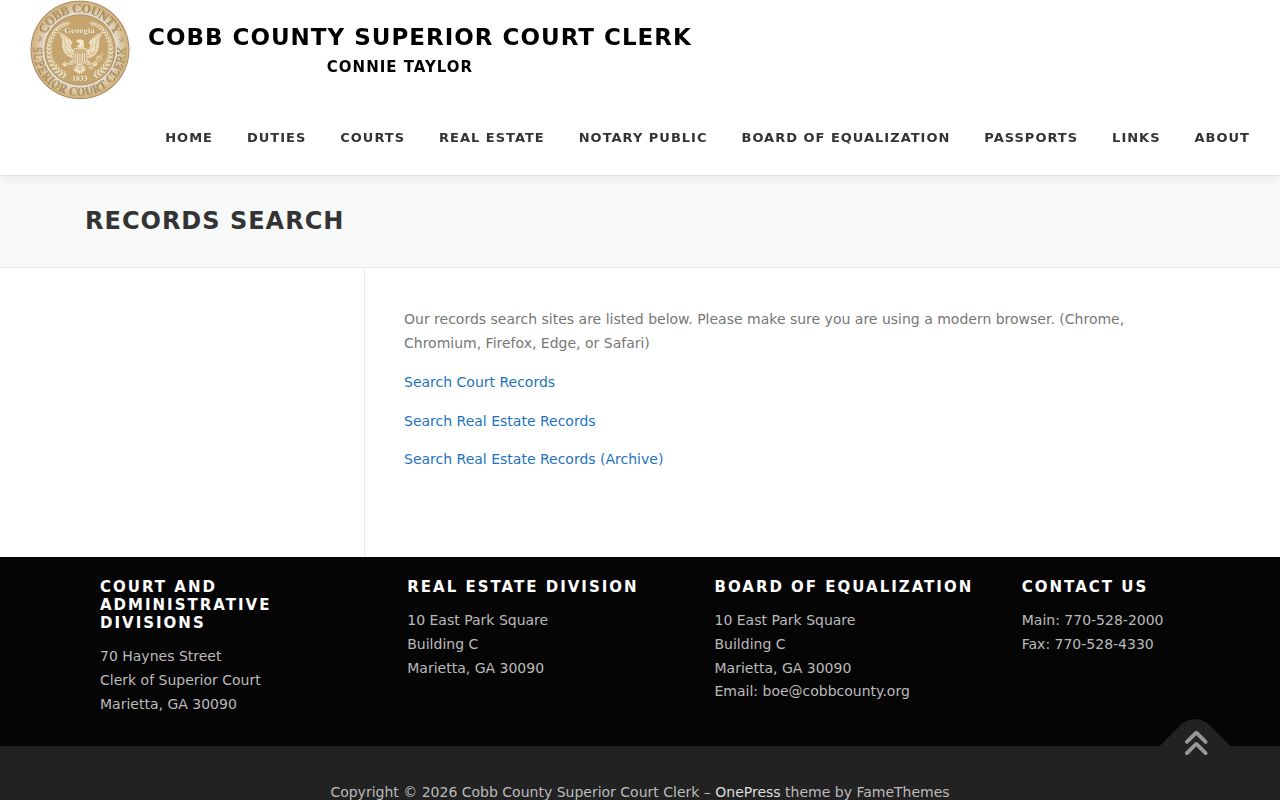
A written copy request should include book/page or CFN. It should also list instrument type, date, parties, legal description, copy count, and whether plain or certified copies are wanted. Payment must be an advance cashier's check or money order; no personal checks. Posted guidance prices regular copies at 50 cents per page and $2 per certified document. Confirm the real-estate charge. The clerk archive hub gathers additional record paths.
This offline route matters when the portal's date range, street coverage, or image access does not reach the needed era.
Cobb County Estate Chain Links
A deceased owner can snap a clean grantor-grantee sequence. The Probate Document Inquiry searches by application name, document type, event date, and range. It allows public viewing, download, and printing without a login. The system conceals sensitive data. Its index covers 1825 through 2025, with 2026 additions posted quarterly.
Match letters, wills, orders, or year's-support records to the executor or administrator. That person is named on the recorded deed. Under Georgia access law, a death certificate is only a date clue. It never authorizes a sale. Where authority is not found, preserve the gap and request whatever probate record exists.
Cobb County Tax Digest Clues
Tax digests can pin a name to a year. Acreage, land lot, and taxable description can be pinned too. This helps when the deeds run unclear. They support conveyances but never replace them. Local finding aids list Cobb tax digests and district plat surveys dating from 1832. A homestead book spans 1866 to 1928. A land-lot index covers 1868 to 1938. Check each range against the actual volume or reel. The Georgia Archives Cobb county card routes researchers to microfilm. Its codes are CC034 and Virtual Vault ID 101.
The Georgia Room at Switzer Library adds directories, maps, newspapers, and microform. Vertical files and staff help round it out. Cite year, reel, book, and page. Then compare adjacent tax years against the deed dates.
Note: A city directory's owner or renter mark can be stale and never proves recorded title.
Cobb County's 1864 Record Gap
Cobb County's civil archives burned in 1864, according to Georgia Archives. No chain of title can cross the Civil War with confidence. Some bound material survived on microfilm, though. Georgia Archives and Georgia State University hold copies. These run through roughly 1900. FamilySearch can also locate cataloged books. Later copies, however, cannot be assumed to repair every link the fire destroyed.
Work backward instead. Start with later deed citations. Then convert each description to district and land lot. Then inspect the surviving deeds and plats, compare the tax digests, and search probate files. Record every book, reel, year, and name checked. A bounded gap, plainly stated, beats a seamless list built on weak name matches.
Set Cobb County Chain Limits
Cobb County ownership research rarely ends on one tidy date. The current online index shows a cutoff. Street mode reaches back only to 1999. The separate archive series each cover different spans. The 1864 courthouse loss can wipe out whole stretches of early property records. Whole deed chains sit broken where a family expected continuity. Plats, tax digests, probate files, land-lot indexes, and city directories can help bridge those gaps. They carry less legal weight than a recorded deed.
Stop your search at the last instrument you can verify. Or stop at a historic source you can cite. Note every spelling variant, former parcel number, subdivision, land lot, and archive along the way. Legal title may turn on a link that is missing. A professional title examination is the right next step. For pulling a single recorded instrument, the Cobb County deed records route lays out the steps.
State the gap. Former-owner research supports house history, estates, and title diligence. Do not use historic names or addresses to stalk, harass, or harm anyone.