
Deed Types in Cobb County Records
Deeds, plats, liens, and condominium papers all pass through the Cobb County Superior Court Clerk's Real Estate Division. Recording proves only that the instrument entered the public record. Its real effect turns on the deed language, proper execution, the parties, and the chain surrounding it.
| Deed Type | What It Does | Common Use |
|---|---|---|
| Warranty deed | Conveys the described interest with stated title promises. | Ordinary ownership transfer |
| Quitclaim deed | Conveys whatever interest the grantor has without title warranties. | Interest release or chain cleanup |
| Security deed | Secures a Georgia real-estate loan and is not a sale deed. | Financing and later release |
| Executor or trustee deed | Transfers through an authorized fiduciary. | Estate or trust administration |
| Tax deed | Records a tax-sale conveyance subject to redemption and title issues. | Delinquent-tax sale |
A security deed, lien, lis pendens, easement, release, or plat can shape the same parcel. None of them plays the transfer deed's role. Search the whole instrument family, then chase any later cancellation, release, assignment, or correction tied to it.
Cobb County Real Estate Division
Deeds in Cobb County are recorded by the Real Estate Division, which serves as the county recorder. Visitors will find it at 10 East Park Square, Building C, Marietta, Georgia 30090-9640. The deed room sits on the first floor, along with the plat and map counter. Head upstairs to the second floor to file documents.
Several phone lines serve different needs. General recording questions go to 770-528-1360, the deed room to 770-528-1328, indexing to 770-528-1332, and liens to 770-528-4022 or RealEstateLienDesk@cobbcounty.org. Counters operate Monday through Friday, 8:30 a.m. to 5 p.m., though recording and copy services stop at 4:30 p.m. Mail reaches the office at P.O. Box 3430, Marietta, GA 30061-3430.
Search Cobb County Deed Fields
The current name-search form handles detailed grantor-grantee queries. Enter people last name first, no comma. Partial names are fine. Try initials, former names, punctuation, and business suffixes before concluding a deed record is missing.
| Field | Control or format | Use |
|---|---|---|
| Name | Text, up to 40 characters | Person or indexed business |
| Date range | All years, recent spans, or From and Thru | Narrow around a transfer |
| Book type/category | Deed, plat, lien, UCC, and other families | Separate record classes |
| Party direction | Both, grantor only, or grantee only | Trace outgoing or incoming title |
| Instrument type | Optional county code list | Isolate deed, release, lien, or plat |
Index data on the clerk's landing page runs through October 1, 2024. For anything recorded later, verify coverage with the clerk or the current electronic filing system. Treat a blank online result as a prompt, not a verdict.
Trace Cobb County Deeds by Party
The grantor conveys the interest; the grantee takes it. A chain of title links every transfer instrument for the same land, in order. Start at the most recent transfer you know, then test each party in both directions.
- Find the likely buyer as grantee near the known sale date. Open the deed image and compare its legal description with the target land.
- Copy the grantor's exact indexed name plus the deed book/page or CFN. Record any prior-deed citation in the image.
- Search that grantor as an earlier grantee. Repeat the process while checking correction deeds, quitclaims, estate deeds, and plats.
- Switch to Land, Book/Page, or Cross Reference when the name path breaks. For older gaps, use archives, tax digests, and probate.
- Grantor
- The party named as transferring the stated interest.
- Grantee
- The party named as receiving the stated interest.
- Chain of title
- The ordered set of instruments that links interests in the same land over time.
- Book/page
- A volume and page citation for a recorded image.
- CFN
- A clerk file number made from a record type, year, and sequence.
Land Search for Cobb Deeds
The clerk's Land Description search often beats a street search. It accepts land district, land lot, subdivision, block, lot, unit, date range, book type, instrument, party direction, and referenced name. At minimum you need a subdivision or land district. The official Cobb County land-search form displays those deed and plat filters together.
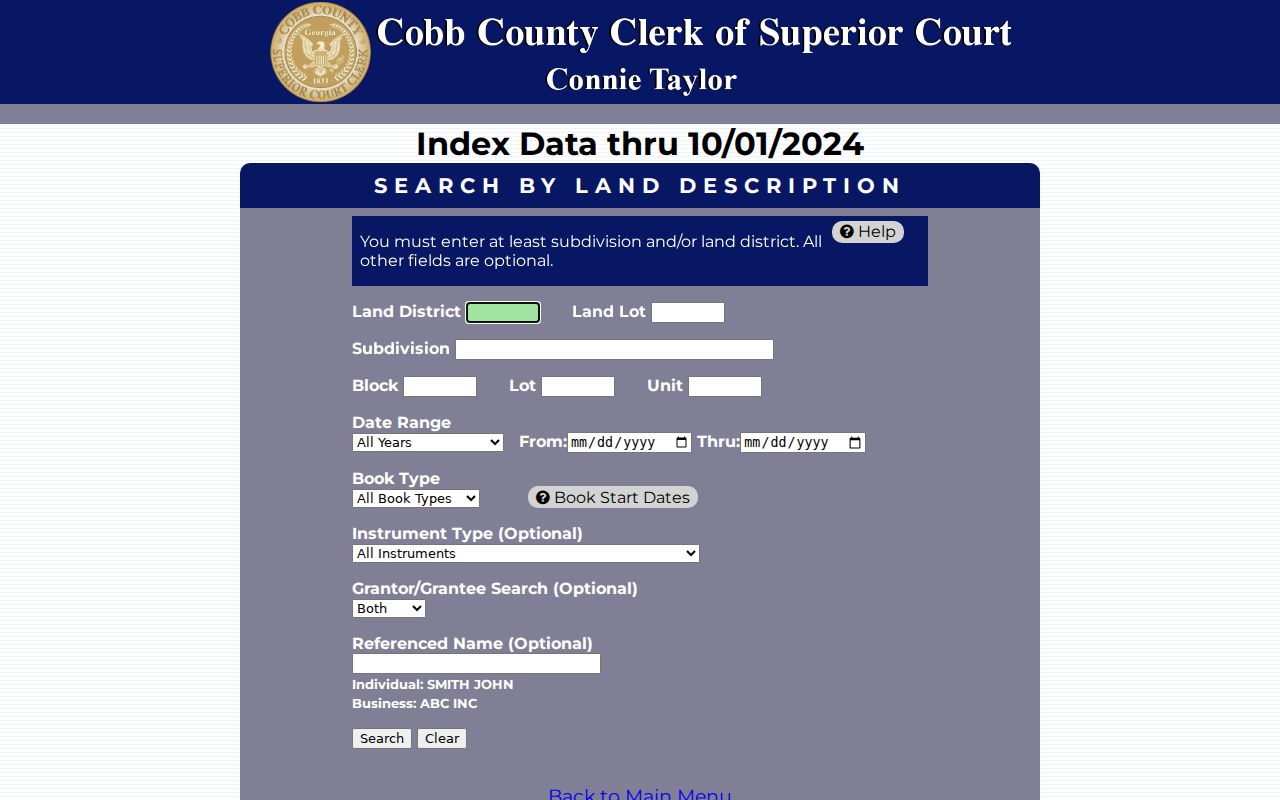
When a street-based deed search stalls, land district and subdivision give you solid fallbacks. Run the subdivision alone first. Then layer in phase, block, or lot. Search Plat Book and Deed Book separately. Georgia's land-lot and recorded-plat descriptions outlast modern street labels, so this route can reconnect a chain after an address change.
Note: The clerk's Street mode holds data only from January 1, 1999, so it is no substitute for a full historic deed search.
Cobb County Filing Rules
A warranty or quitclaim deed should name the grantor, grantee, and legal description. It should carry signatures with notarization and a witness. It should also follow the PT-61 transfer-tax route. The security deed is the loan instrument. Cobb's clerk notes that one maturing beyond three years should be filed within 90 days. This avoids the consequence Georgia law describes.
Since January 1, 2025, most self-filers must use the GSCCCA eFile system. Individuals must complete identity and photo verification. Listed professional and public filers may still submit paper. Confirm eligibility, format, tax forms, and current charges before filing a new instrument.
Cobb County Deeds Before 1900
Cobb County's 1864 Civil War loss damaged civil archives. That explains why a modern courthouse search may not produce a clean nineteenth-century chain. It does not mean the older evidence vanished. Microfilm at Georgia Archives covers much of the bound county record. Georgia State University holds microfilm as well. Both reach back through about 1900. Start with the Georgia Archives county-record card. Then work through tax digests, plat indexes, probate material, and deed-book microfilm. The Georgia Room at Cobb County Public Library adds maps, directories, microform, vertical files, newspapers, and librarian help. State each gap plainly. Never claim a complete chain where the record will not support one.
Monitor New Cobb Recordings
The clerk's Fraud Alert Notification System watches a personal or business name and sends electronic notice of matching filings. Its form also gathers contact, parcel, address, and legal-description details.
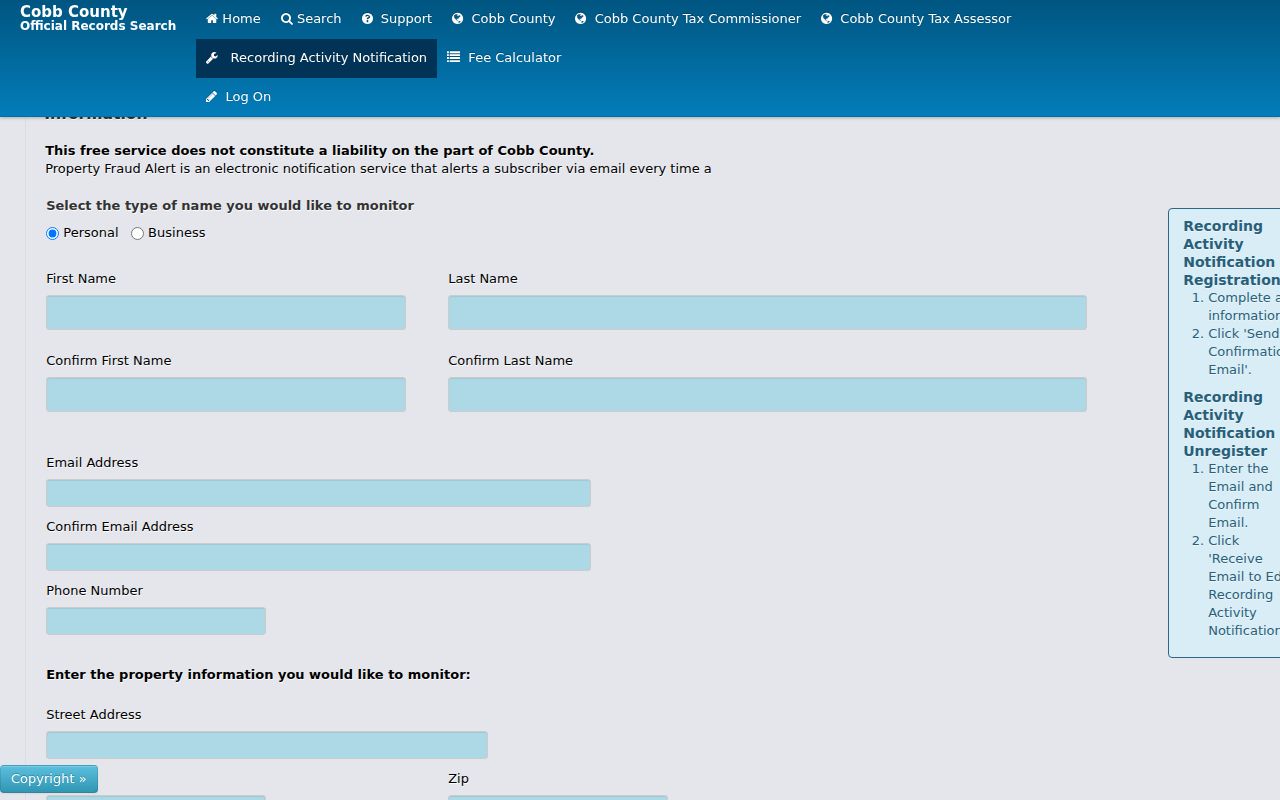
The alert form itself collects both a name and parcel details. That pairing helps narrow a recording notice. It still does not turn the service into proof of title. An alert is a prompt to inspect a filing. It blocks no deed and validates no instrument. It insures no title and proves nothing about the parcel affected. Match the notice to the recorded image and its legal description. Contact the clerk or qualified counsel if the instrument looks suspect.
Order a Cobb County Deed Copy
Start with the index. Pull the book and page number or the CFN for the deed you need. If a scanned image is available online, review it there before ordering anything. Office copies run 50 cents per page. Certification adds $2 per document for in-person or courier service. The Real Estate Division can confirm the current certification route before you pay.
Mail requests take more care. Write out the request. Prepay it with a cashier's check or money order. Personal checks are not accepted. Be sure to include the instrument reference, the parties, the record type, and your return address. State plainly whether you want a plain copy or a certified one. Copy fees are not the same as fees for recording a new deed. The posted schedule lists that fee at $25 for the first page with no added per-page charge. Check the full fee schedule before you submit anything.
Recorded, not guaranteed. Cobb County deed records show accepted filings. They are not a title opinion, and an index row alone cannot prove clear ownership.