
Run a Cobb County Property Search
The official Tax Parcel Viewer is the best starting point for a Cobb County property search. Type a house number and street into its form. Skip the unit, city, state, and ZIP. The result gives you a PIN and jurisdiction, and that parcel number unlocks everything else, from the assessor and tax estimate to the deed index and the correct planning office for the property.
- Enter only the normalized house number and street in the county viewer. Try the base street name again if a suffix or direction blocks a match.
- Copy the PIN, situs address, jurisdiction, land district, land lot, tax district, and any subdivision clue from the parcel card.
- Use the PIN, address, or owner in the tax estimator and the assessor-linked property search. Note the tax year and retrieval date.
- Carry the owner name and land description to the Superior Court Clerk's real-estate index. Read the latest instrument image, not just its index row.
- Check tax, zoning, permit, plat, lien, or court records only as the question requires. Request a plain or certified copy from the custodian when needed.
This route keeps unlike records tied to the same land. It also reveals a common mismatch. The current deed can be newer than the assessment roll. So save an as-of date for each result. Do not merge every field into one undated profile.
Cobb County Address Search Rules
The parcel viewer's address rule is unusually strict. That strictness is useful. Enter a form such as 1682 WHITLOCK RD, never a full postal label. Skip the apartment or unit, city, state, and ZIP. A failed full-address query does not mean Cobb County has no parcel record. The official Cobb County Tax Parcel Viewer provides the address search interface.
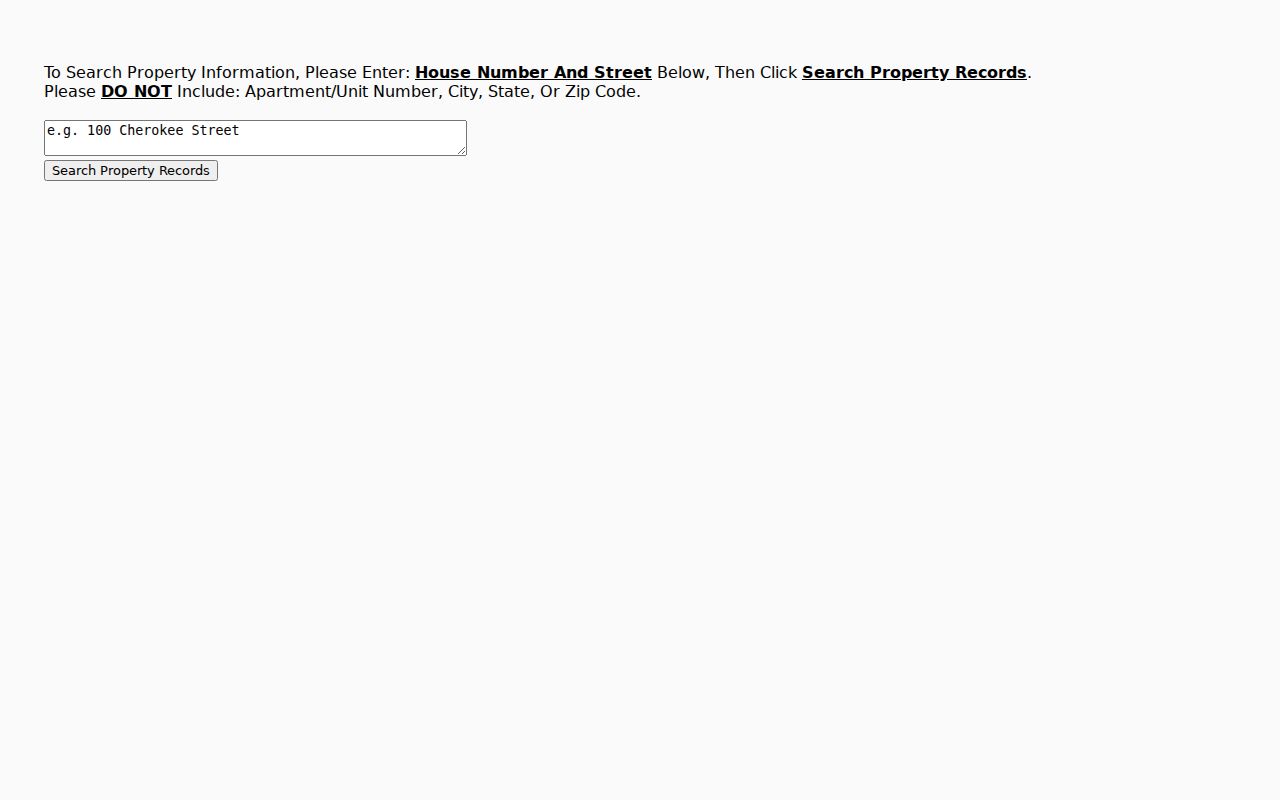
The official search page displays the short address format. It also shows the county's direct property-record search action.
When an address has changed, drop the street text. Search by land district, land lot, subdivision, block, lot, and unit instead. Cobb's deed system keeps those land-description fields. A legal description can outlast a street number. Treat ZIP as a hint only. It proves nothing about Marietta, Mableton, Smyrna, or unincorporated jurisdiction.
Note: Preserve both the situs address and mailing address when shown, since they describe different things and should not be silently swapped.
Cobb County Parcel Card Fields
A Cobb County property search result in the GIS viewer is a routing card. It identifies the parcel and the public services tied to it. It does not say the displayed person holds marketable title. Nor does it replace a survey.
| PIN and situs | The parcel key and physical property address. |
|---|---|
| Land description | Land district, land lot, and links that help reach plats and deeds. |
| Tax context | Tax class, tax district, ZIP, and jurisdiction. |
| Planning context | Zoning and future land use for unincorporated parcels. |
| Service context | Commission, fire, police, sheriff, precinct, and school fields. |
The card also links to the clerk's Land search, My Neighborhood Map, the assessor report, and the Georgia My Voter Page. Treat those links as separate records. A school field, for instance, is a service clue rather than proof of city limits or ownership.
The Whitlock Parcel Test
One Cobb County address shows how this works in practice. A search for 1682 Whitlock Road returned PIN 16070300110. It also returned land district 16, land lot 703, and tax district 9. The parcel sits in unincorporated Cobb County. It carries an R3 tax class, R-20 zoning, and residential future land use. The ZIP is 30066. The same record lists district, precinct, school, and public-safety fields. A single parcel number can answer questions well beyond ownership and value.
Treat this as a reproducibility test, nothing more. It says nothing about title or market value. Nearby Whitlock addresses return other PINs, which is the real lesson. Two homes can share a road name and sit a short walk apart. They can still land in entirely different parcels on the tax roll. Visual closeness does not tie records together. Only the parcel number does that. That is why every careful Cobb County property search ends with the PIN written down and checked.
What Cobb County Search Results Show
No single Cobb County property record holds every useful field. The GIS card supplies the spatial and jurisdiction key. The tax estimator adds a dated tax-year snapshot, the assessor maintains fair-market and assessed values, and the clerk index provides recorded instruments and party names.
| Owner of record | A tax-roll lead that should be checked against the newest deed. |
|---|---|
| Situs and mailing address | The land's location versus the address used to contact the named owner. |
| PIN | Cobb's parcel identifier, used to reconcile GIS, tax, and assessment results. |
| Fair-market and assessed value | Dated assessor figures; ordinary Georgia real property is generally assessed at 40% of fair market value. |
| Legal description | Land lot, subdivision, lot, plat, or metes-and-bounds text that identifies the land. |
| Recording reference | Book/page or CFN information used to retrieve the actual instrument. |
The assessor-linked qPublic form does not render for automated sessions, so its live fields should not be guessed. Use the office directly or a normal browser session when that result matters. A blank owner display can also reflect protected-person redaction or an entity name rather than ownerless land.
Cobb County Deed Search Modes
The Cobb real-estate index offers several ways to turn a parcel lead into a recorded-document lead. Its displayed index data runs through October 1, 2024. A 2025 or 2026 search needs direct confirmation with the clerk or through the eFile route.
| Mode | Fields that matter | Best use |
|---|---|---|
| Name | Name, date range, book type/category, grantor or grantee, instrument | Owner and transfer searches |
| Land | District, land lot, subdivision, block, lot, unit, party | Changed addresses and plats |
| Street | Number, direction, street, suffix, unit, city, date, book, name | Discovery from 1999 forward |
| Book/Page | Book type, book, page | Known citations |
| CFN or cross-reference | Type, year, sequence, or referenced instrument | Exact index references |
For people, enter the last name first without a comma. Test initials and spelling variants too. Search a seller as grantor and a buyer as grantee. For a business, keep the exact indexed suffix. Compare it with the Georgia Secretary of State only when entity context matters.
Cobb County Tax Search Results
The Cobb tax estimator accepts parcel ID, property address, or owner name in one autocomplete field. Its results include parcel ID, address, class, tax district, property type, data-retrieved date, tax year, fair-market value, assessed value, estimated taxes, exemption, and owner.
The 2026 estimate draws on 2025 millage and assessment data. It excludes agricultural or special classifications and parcels under administrative review, and city tax stays separate. Penalties, interest, delinquent balances, and fees are not part of the estimate. Compare it with the actual bill at the Tax Commissioner.
Note: Keep tax year, data-retrieved date, notice date, and millage year as four separate facts.
Cobb County Search Terms Defined
Three labels do most of the work in a Cobb County property search. Learn them before copying any data into a report.
- PIN
- The county parcel identifier used to connect map, assessment, and tax records.
- Situs address
- The physical location assigned to the land, which may differ from the owner's mailing address.
- Owner of record
- The name carried on a current public roll or instrument, subject to timing and redaction limits.
- Plat
- A recorded drawing that lays out lots, blocks, easements, or subdivision geometry.
A PIN is not permanent. A split, recombination, annexation, or mapping update can change it, leaving an older deed file under a key that no longer resolves. When that happens in Cobb County property records, the legal description and the recorded plat carry the thread, tying the new parcel number back to its parent parcels in the deed records.
Choose a Cobb County Search Key
Address, owner, and PIN searches each answer a different question. Use two keys when the result matters. A second route through the Cobb County property search can surface a spelling error, a stale mailing address, or a parcel change that one field alone hides from view.
| Search Key | Best For | Where It Works | Watch Out |
|---|---|---|---|
| Address | Finding one physical site | GIS, tax estimator, street index | Old numbers, suffixes, and mailing-city confusion |
| Owner name | Finding party-indexed records | Tax estimator and clerk Name mode | Trusts, estates, entities, initials, and same names |
| PIN | Matching the current mapped parcel | GIS, assessment, and tax routes | Splits, combinations, and format changes |
| Land description | Following land across address changes | Clerk Land mode and plats | Phase names and historic abbreviations |
Not a title search. A Cobb County property search finds public leads. It does not guarantee clear title, locate every unrecorded claim, or establish a surveyed boundary.
When the online path fails, go to the custodian. The Real Estate Division sits at 10 East Park Square, Building C, in Marietta. It keeps a deed room and a plat counter. It also accepts written mail-copy requests for deed records with advance payment. The assessor sits at 736 Whitlock Avenue, Suite 200. Historical research can continue offline. The Georgia Archives offers a county card. Old tax digests and deed books help as well. So does the Cobb library's Georgia Room.