
Fields in Cobb County Tax Records
Cobb County property tax records are split across two offices. The assessor keeps the parcel number, ownership, and value fields, while the Tax Commissioner handles the bill itself. Read the fields as a dated set rather than a single truth. An appraisal from one year can sit beside a tax bill built on older or newer figures. The assessor's value is only one input in a bill. The bill can also carry district and exemption effects that a deed does not show.
| Field | What It Shows | Where |
|---|---|---|
| Fair-market value | The assessor's estimate of full value as of the assessment date. | Board of Tax Assessors |
| Assessed value | The taxable assessment base before applicable exemption effects. | Board of Tax Assessors |
| Exemptions | Homestead or other qualified relief carried for the account. | Tax Commissioner and assessor records |
| Tax district and millage | The jurisdiction and rates applied to the taxable base. | Tax bill and estimate |
| Bill and status | Tax due, payment, delinquency, penalties, or collection stage. | Tax Commissioner |
Cobb County tax records start from Georgia's standard ratio: ordinary real property is assessed at 40% of fair-market value. That figure is not a sale price. Exemptions, special classifications, city taxes, and millage rates all shift the tax bill, while the deed's sale consideration stays exactly what the deed says it was.
Cobb County Tax Estimate Fields
The official Cobb tax estimator takes a parcel ID, a property address, or an owner name in a single search box. It serves as the county's entry point for a Cobb County property tax search when you want a planning figure. The estimator page also shows the tax-year inputs it uses, so you can see which millage and assessment assumptions feed the result. It is a bridge tool. The actual bill still comes from the Tax Commissioner.
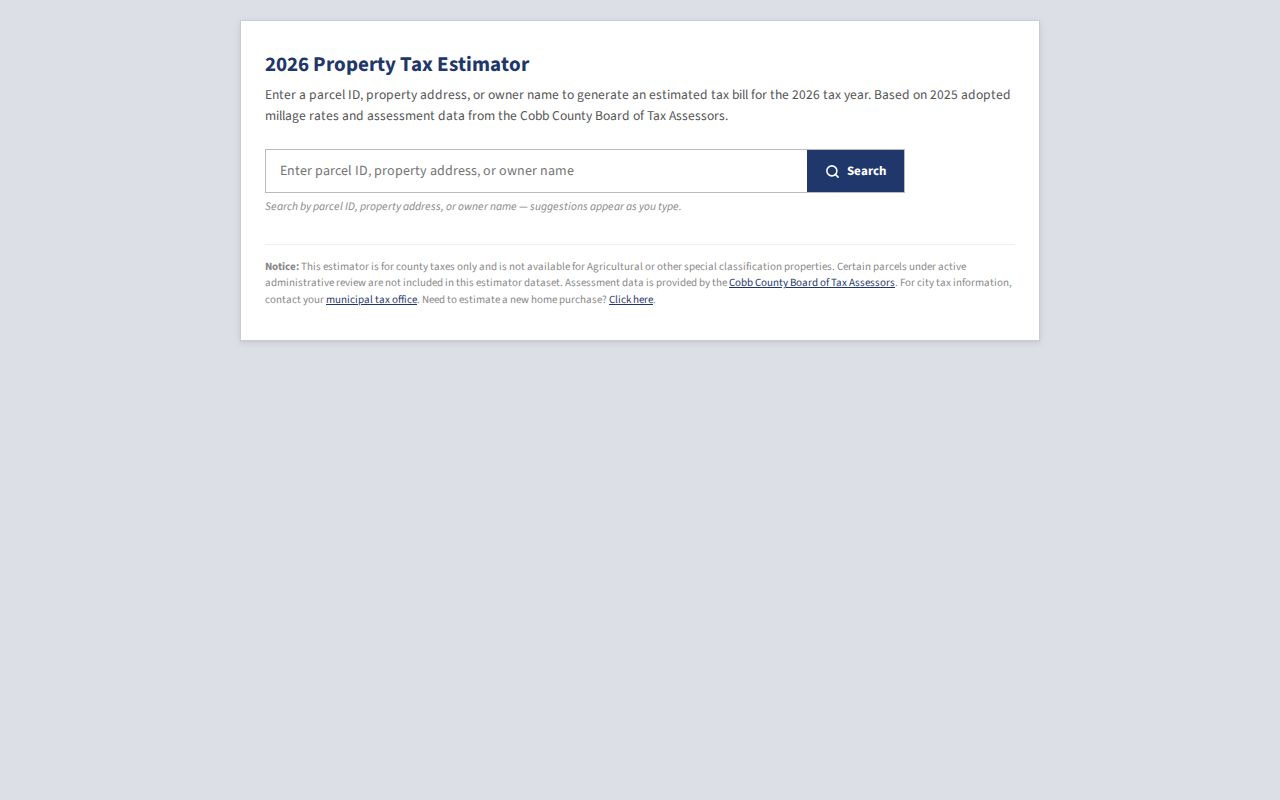
The estimator returns a dated estimate, not a bill. Always compare its figure against the actual tax bill before relying on either number.
| Result field | Meaning | Check before use |
|---|---|---|
| Parcel ID and address | The account match | Compare with current GIS PIN and situs |
| Class, district, type | Tax and property categories | Check city or special layers |
| Data retrieved and tax year | The estimate's time frame | Keep both dates |
| Fair-market and assessed value | Assessor-sourced value fields | Compare with annual notice |
| Estimated taxes and exemption | A planning figure and relief shown | Compare with actual bill |
The 2026 estimator draws on 2025 millage and assessment inputs. Agricultural and special classifications are left out. So are parcels under administrative review, along with penalties, interest, delinquent balances, and fees, and city tax is billed separately from the county tax roll.
Cobb County Annual Assessments
January 1 is the annual assessment date. Cobb's assessor reviews property every year instead of following a fixed statewide three-year cycle. A new value can reflect sales evidence, permits, mapping work, classification, a correction, an exemption change, or a broader review. Annual notices go to owners before July 1. The 2026 residential, commercial, and personal-property notices were mailed June 5, and that notice switched the estimate display to show estimated savings. Keep the notice itself, the envelope, the USPS postmark, the PIN, the prior and new value, the class, the exemptions, and the printed appeal deadline.
Note: A taxpayer return filed early in the year reports a claimed value; it is not an assessment appeal.
Find a Cobb County Tax Bill
The Cobb Tax Commissioner site is the source for the actual tax account and payment status. Carla Jackson serves as Tax Commissioner. General help is at 770-528-8600 or tax@cobbtax.gov, and property-tax mail goes to P.O. Box 100127, Marietta, GA 30061-7027. Bring the parcel number for the fastest service.

The Tax Commissioner's page is the official route to a bill or payment record. Keep that record separate from the estimator's planning figure, since only the bill reflects the true amount owed on the parcel.
- Confirm the address and PIN in county GIS before opening the tax route.
- Search the tax account and record bill year, district, amount, payment status, and any balance.
- Compare fair-market and assessed value with the annual notice and estimator's dated inputs.
- Check the exemption line and any separate city tax. If delinquent, inspect lien, levy, sale, and redemption records.
- Assessed value
- The value to which tax rules and exemptions are applied, generally 40% of fair market value for ordinary Georgia real property.
- Millage
- A tax rate expressed per thousand dollars of the taxable base.
- Homestead exemption
- Qualified relief for an owner who owns and occupies the home under the filing rules.
- Tax lien
- A public claim tied to unpaid tax, which is distinct from the later tax-sale deed process.
Cobb County Homestead Records
The Cobb exemption instructions require the applicant to own the home on January 1. The applicant must also occupy it. Every name on the deed should be listed. Georgia driver-license information should show the property address. Vehicle registration belongs in the stated proof set. Only one homestead exemption is allowed per household. A home that is rented, sold, or no longer occupied must be updated with the office. Cobb's operational codes cover basic, age-related, disability, disabled-veteran, surviving-spouse, and peace-officer or firefighter categories. Eligibility and income limits vary, so the current local form and notice control.
Cobb County Assessor Access Gaps
The assessor links to a Schneider qPublic property search, but its live form sits behind an access gate in some sessions. That means fields like owner name, mailing address, sale history, land value, improvement value, and exports cannot be assumed without a successful lookup. Cobb GIS and the tax estimator work as independent discovery tools for parcel-level fields. Open qPublic in a normal browser session. Or contact the Board of Tax Assessors at 770-528-3100. A missing owner name on a parcel may reflect a qualifying protected-person redaction. That is not proof the parcel has no legal owner. Treat the gap as a limit of the portal, not of the records themselves.
Cobb Tax Sales and Redemption
Property tax unpaid after October 15 can move into levy and sale. The tax-sale page links current and delinquent lists, excess-funds files, claim forms, and the county booklet. The page also hosts the county booklet. Listings run in the Marietta Daily Journal on Fridays for four weeks before a sale. The posted 2026 nonjudicial dates were May 5 and November 3. Sales run from 10 a.m. to 4 p.m. at Superior Court Plaza. Bidders preregister and receive cards in person with photo ID. Bidders also pay in full by cash or certified funds. No mail, phone, or fax bidding is accepted.
A sale yields a tax deed, not immediate possession or clear title. A statutory redeemer generally has 12 months. The redemption calculation includes the bid, later tax and special assessments, statutory premiums, and costs. An excess-funds entry opens a claim workflow rather than proving present ownership. So check the deed records and tax roll together before drawing conclusions about any parcel.
Contest a Cobb County Assessment
A Cobb County appeal can target value, uniformity, taxability, or another assessment matter. Put it in writing. Identify the parcel or address and state your basis. The assessor must receive it within 45 days of the notice. Or USPS must postmark it within that window. A private meter date does not control the postmark.
The appeal route begins with assessor staff and the Board of Tax Assessors. The BTA must decide within 180 days. From there, a Board of Equalization appeal is available within 30 days of that decision. Hearing-officer review applies only to qualifying non-homestead real property above the stated value threshold. Arbitration of real property requires a certified appraisal. Superior Court review carries its own 30-day deadline and a stated $25 filing fee.
Appeal window. File within 45 days of the notice. Cobb states that there is no extension, so verify the exact deadline printed on the current notice.
File at the Board of Tax Assessors, 736 Whitlock Avenue, Suite 200, Marietta, GA 30064, or use the current official filing route. Bring your evidence. Comparable sales, photos, permits, maps, classification facts, and proof of any error all strengthen a property tax appeal. The assessor's forms page also carries taxpayer returns, redaction requests, address changes, personal-property forms, Freeport applications, and exemptions.